This post contains affiliate links. If you buy through them, we may earn a commission at no extra cost to you. Learn more.
Solar power turns your RV into a self-sufficient home. With the right kit, you can camp off-grid for days or weeks without running a generator. Here’s what you need to know before you buy.
The parts of an RV solar system
- Solar panels capture sunlight and turn it into electricity.
- Charge controller regulates power from the panels to the battery. MPPT controllers are more efficient than PWM.
- Batteries store energy for night and cloudy days. Lithium (LiFePO4) is lighter and longer-lasting than lead-acid.
- Inverter converts battery DC power to household AC power for outlets.
Many “kits” include panels, a controller, and wiring only. Check whether batteries and an inverter are included.
Roof-mounted vs. portable panels
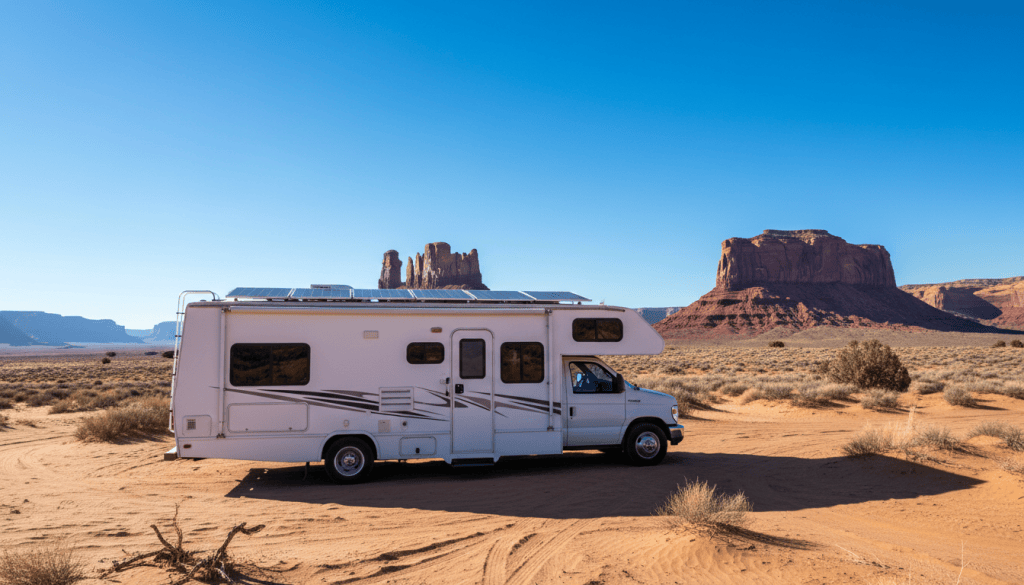
- Roof-mounted (rigid): always on and charging while you drive. But they can’t chase the sun if you’re parked in shade.
- Portable (folding): no drilling, you can aim them at the sun, and you can park in shade. But you have to set them up and store them.
- Flexible panels: lightweight and low-profile, though they usually run hotter and wear out faster than rigid panels.
How big a system do you need?
Start with your daily power use in watt-hours. (Our power station guide shows how to calculate it.) As a rule of thumb, a panel produces about 4–5 hours’ worth of its rated output on a good sunny day:
- 100–200W: keeps batteries topped off and covers lights, phones, and a water pump. Good for weekenders.
- 400–600W: covers remote work, fans, and a 12V fridge. Great for part-time boondockers.
- 800W and up: for full-time off-grid living, especially with a residential fridge or heavier loads.
Expect less output in winter, on cloudy days, and at northern latitudes, so it pays to oversize a little.
The easy route: a solar generator
Not ready to wire a system into your rig? Pairing portable panels with a power station (often sold together as a “solar generator”) is plug-and-play and moves easily between vehicles.
Our top picks
1. Renogy 400W Premium Kit (Best Roof Kit)
A complete, turnkey roof system for full-timers and serious boondockers, with an efficient MPPT controller and Bluetooth monitoring so you can check your power from your phone.
- Four 100W panels (400W total)
- 40A MPPT charge controller
- Bluetooth module, mounts, and cables included
2. Renogy 200W N-Type RV Kit (Best Mid-Size Kit)
A tidy middle ground for part-time boondockers who want more than a starter kit without going all-in.
- 200W of high-efficiency N-type panels
- Adventurer 30A charge controller
3. Renogy 100W Starter Kit (Best Budget Starter)
The classic way to try solar without a big investment. Start with one panel and add more later.
- 100W monocrystalline panel
- 30A PWM controller
- Expandable to 400W
4. Renogy 200W Foldable Panel (Best Portable)
No drilling required. Park in the shade, set this panel up in the sun, and plug it into your power station.
- 200W, about 25% efficiency
- Folds up; around 14 lb
5. BougeRV Arch Pro 200W Flexible (Best for Curved Roofs)
A low-profile flexible panel that follows the curve of rounded RV and camper roofs where rigid panels won’t sit flat.
Want the easy route? Pair the foldable panel with one of our top power stations. Specs are from the manufacturers; check the listing for current pricing.
Installation tips
- Use the correct wire gauge and fuses. Undersized wiring wastes power and can be a fire risk.
- Seal every roof penetration with a self-leveling sealant designed for RV roofs.
- If you’re not comfortable with electrical work, hire an RV solar installer.
Solar plus smart camping spots means free nights under the stars. Learn how in our boondocking guide.


Leave a Reply