This post contains affiliate links. If you buy through them, we may earn a commission at no extra cost to you. Learn more.
For a lot of RVers, reliable internet decides whether a campsite works or not, especially if you work remotely. Here’s a rundown of your options and how to build a setup you can count on.
1. Satellite internet
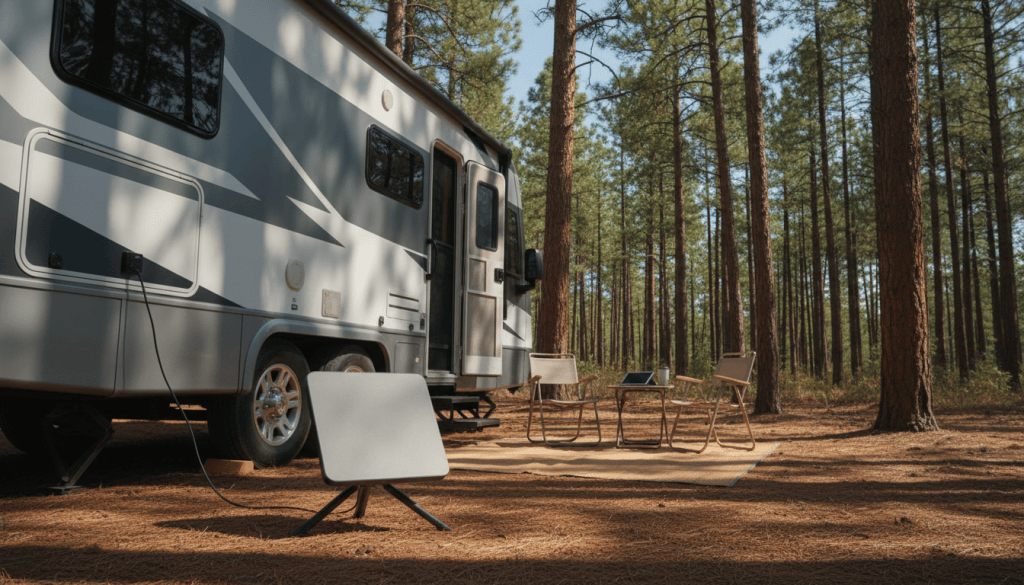
Low-orbit satellite service has changed RV internet. It works in remote areas with no cell signal, as long as you have a clear view of the sky.
- Pros: works almost anywhere, with speeds good enough for video calls and streaming.
- Cons: equipment cost, monthly fees, higher power draw, and trouble under heavy tree cover.
2. Cellular hotspots and data plans
A dedicated mobile hotspot, a travel router with a SIM card, or your phone’s hotspot can deliver fast speeds wherever there’s good signal.
- Pros: low power use and affordable equipment, with fast 5G in many areas.
- Cons: coverage gaps in remote areas, and some plans slow you down after a data cap.
Tip: carry plans from two different carriers. When one has no signal, the other often does.
3. Cell signal boosters
A booster with a roof-mounted antenna can turn one weak bar into a usable connection. It won’t create a signal where there isn’t one, but it can make the difference in fringe areas.
4. Campground Wi-Fi
Nice when it works, but campground Wi-Fi is often slow and crowded. Treat it as a bonus, not your main connection. Use a VPN on public networks.
Which setup is right for you?
- Weekend camper: your phone’s hotspot is probably enough.
- Full-timer who streams: a cellular hotspot with an unlimited plan, plus a signal booster.
- Remote worker who boondocks: satellite internet plus cellular backup on two carriers.
Our top picks
1. weBoost Drive Reach RV (Best Signal Booster)
The go-to booster for RVers. Its roof antenna pulls in weak signal and boosts it for every phone and hotspot inside the rig.
- Up to 50 dB gain
- Works with all major U.S. carriers, 4G and 5G
2. HiBoost Travel 3.0 RV (Booster Runner-Up)
A strong alternative with a weatherproof folding antenna, great for rigs camping at the edge of coverage.
- Up to 50 dB gain
- IP66 weather rating
3. GL.iNet Spitz AX GL-X3000 (Best 5G Router)
Pop in a SIM card and this 5G router becomes your rig’s home internet. It also handles campground Wi-Fi and wired connections, which makes it a favorite of full-time remote workers.
4. Netgear Nighthawk M6 Pro (Best Mobile Hotspot)
A pocket-sized 5G hotspot with a battery, so you can take your connection from the rig to the trailhead café.
- 5G with Wi-Fi 6E
- Ethernet port for a wired connection
5. GL.iNet Beryl AX GL-MT3000 (Best Budget Travel Router)
Grabs one campground Wi-Fi signal and shares it with all your devices on your own private, secure network. It also runs a VPN for safer browsing on public Wi-Fi.
- Wi-Fi 6
- 2.5G WAN port and VPN support
Going the satellite route? Starlink sells its equipment and plans directly. Pair it with a travel router above, and use cellular as your backup. Specs are from the manufacturers; check listings for current pricing.
Don’t forget power
Satellite dishes and routers need steady power, especially off-grid. A portable power station keeps you online when you’re boondocking.


Leave a Reply